Adsorbent Packaging and Export Guide
This Adsorbent Packaging and Export Guide helps industrial buyers define the inner package, outer package, pallet, container securing, labels and shipment documents required for molecular sieves, activated alumina, carbon adsorbents, silica gel and catalyst support materials. The correct arrangement depends on the material, quantity, route, destination and handling conditions—not on the phrase “standard export packing.”
Do Not Use One Packaging Specification for Every Adsorbent
Packaging should control the main risk of the selected material. Hygroscopic products need effective moisture barriers and short exposure times. Powders need dust-tight containment. Dense ceramic media need impact resistance and manageable pallet weight. The shipment plan then adds handling, stacking and destination requirements.
Protect Against Humidity
Molecular sieves, activated alumina and silica gel can adsorb moisture during storage and handling. Confirm the inner liner, sealing method, opening procedure and allowable exposure before use.
Control Dust and Leakage
Powder activated carbon and molecular sieve powder require suitable bag construction, sealed closures, clean handling and review of the product-specific safety and transport information.
Control Impact and Pallet Load
Catalyst carriers, inert ceramic balls and reactor support media need packaging that limits breakage while keeping individual units and pallet loads practical for handling equipment.
Adsorbent Packaging and Export Guide: Match the Pack to the Material
The examples below describe common directions, not fixed standards. Final construction, weight and closure should be confirmed against the actual product, order size, handling method and destination.
| Packaging Format | Typical Direction | Key Points to Confirm |
|---|---|---|
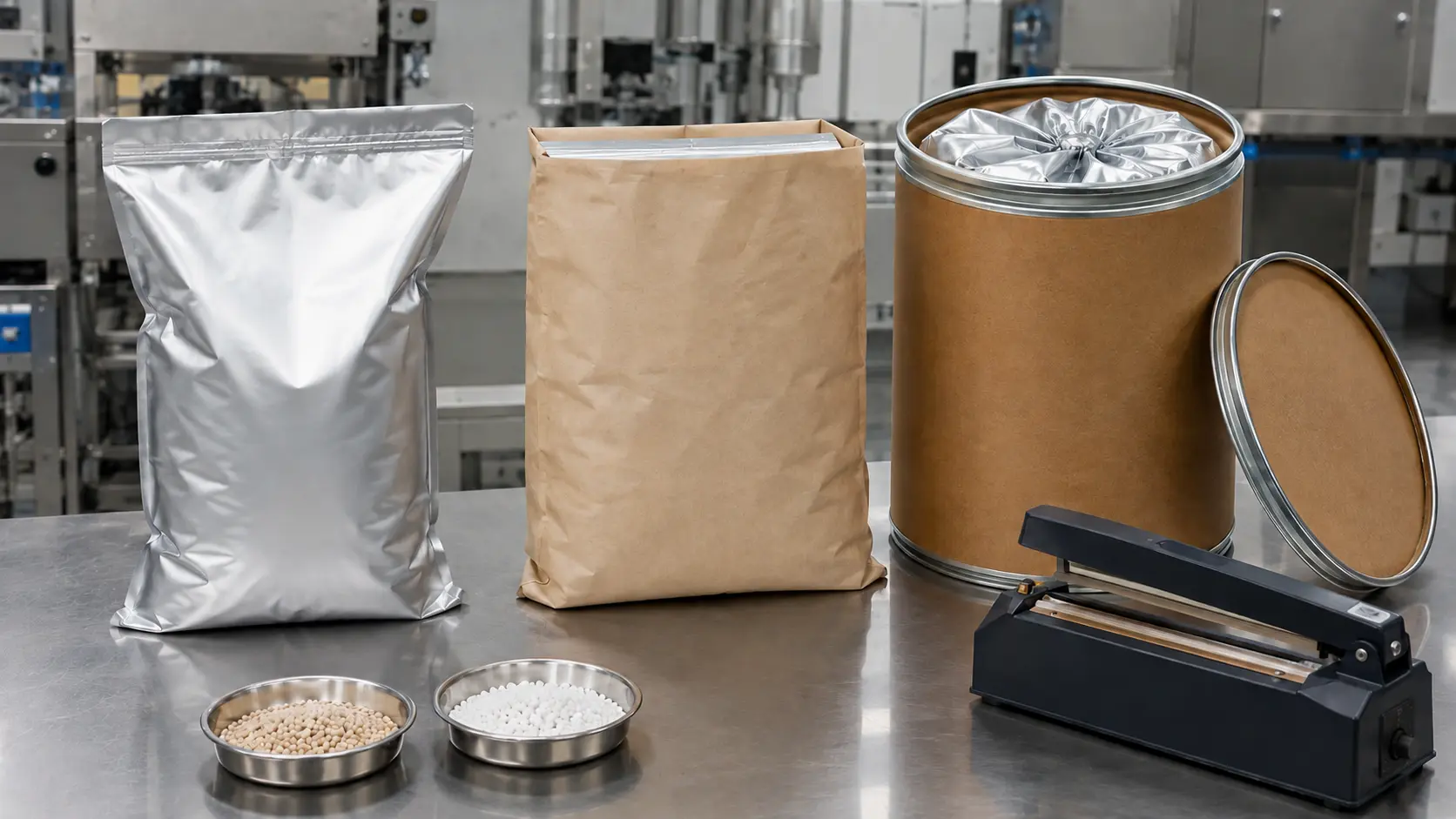
| Multiwall or composite bag | Common for granular or beaded adsorbents when the outer bag provides strength and the inner liner provides the required barrier. | Net weight, liner material and thickness, liner closure, outer-bag closure, puncture resistance and pallet quantity. |
| High-barrier inner bag | Used when moisture ingress must be controlled more tightly during storage and transport. | Barrier structure, heat-seal width and integrity, headspace, sealing validation, secondary protection and opening procedure. |
| Fiber drum or plastic drum | Useful for selected powders, samples, moisture-sensitive grades or customers requiring more rigid handling protection. | Inner liner, lid and closure, seal, net and gross weight, drum compatibility, stack limit and pallet arrangement. |
| Carton with inner units | Common for desiccant packets, small bags, sample units or products divided into smaller use quantities. | Units per carton, inner-unit seal, carton strength, humidity exposure, traceability and maximum stack height. |
| Flexible intermediate bulk container | Possible for selected bulk materials when loading, unloading and dust-control systems are suitable. | Bag rating and construction, liner, discharge design, lifting method, product compatibility, handling route and destination acceptance. |
| Sample container | Small sealed bottle, pouch, bag or drum selected for courier handling and representative sampling. | Sample mass, leak resistance, moisture barrier, headspace, identification, courier acceptance, safety documents and secondary containment. |
| Palletized shipment unit | Bags, drums or cartons consolidated for forklift handling and container loading. | Pallet material and condition, footprint, total gross weight, overhang, layer pattern, corner boards, wrapping, straps and stackability. |
Moisture Protection Depends on the Whole Packaging System
A moisture-sensitive adsorbent can begin taking up water as soon as it is exposed to ambient air. The effective protection therefore depends on the barrier material, seams, closure, headspace, outer package, storage environment and how the package is opened and resealed at the customer’s site.
A foil-looking or plastic-looking liner should not automatically be treated as a verified moisture barrier. The material structure and seal performance must be confirmed. For drums or composite bags, the inner liner should be closed before the outer container is secured; the outer package protects the barrier from puncture and handling damage.
Packaging Moisture Control
For silica gel selection and packaged-goods moisture protection, compare the product format, humidity risk, storage period and real package barrier separately from bulk adsorbent packing.

Palletizing and Container Loading Must Prevent Movement
The package may be strong individually but still fail if the pallet pattern, gross weight or container securing is unsuitable. Bags should not overhang the pallet. Drums and cartons should be arranged within the footprint, and the load should be stabilized using compatible combinations of corner protection, wrapping, strapping and other approved restraint methods.
Container loading must also consider total payload, axle and floor loading, center of gravity, moisture conditions, discharge sequence and weight distribution from front to rear and side to side. Empty spaces should not be left as uncontrolled travel zones. The actual securing plan should be set by the shipper, packer and logistics provider for the cargo and route.
Product Documents and Export Documents Serve Different Purposes
Technical Data Sheets, Safety Data Sheets and Certificates of Analysis are not interchangeable. A TDS describes a product grade or typical specification direction. An SDS communicates product-specific hazard, handling, storage and emergency information. A COA normally reports or confirms the relevant results for an actual batch or lot under an agreed specification and test basis.
Commercial and transport files—such as the quotation, commercial invoice, packing list, transport document and any required origin or destination documents—support the transaction and shipment. The exact file set depends on the product, Incoterm, mode of transport, destination, customer and applicable regulatory requirements.
Document and Export Requirements
Adsorbent Source reviews the requested product grade, packaging, shipment and documentation requirements for procurement. Sample and document availability and content can be checked for each grade and order requirement.
Define the Package, Shipment and Document Set Together
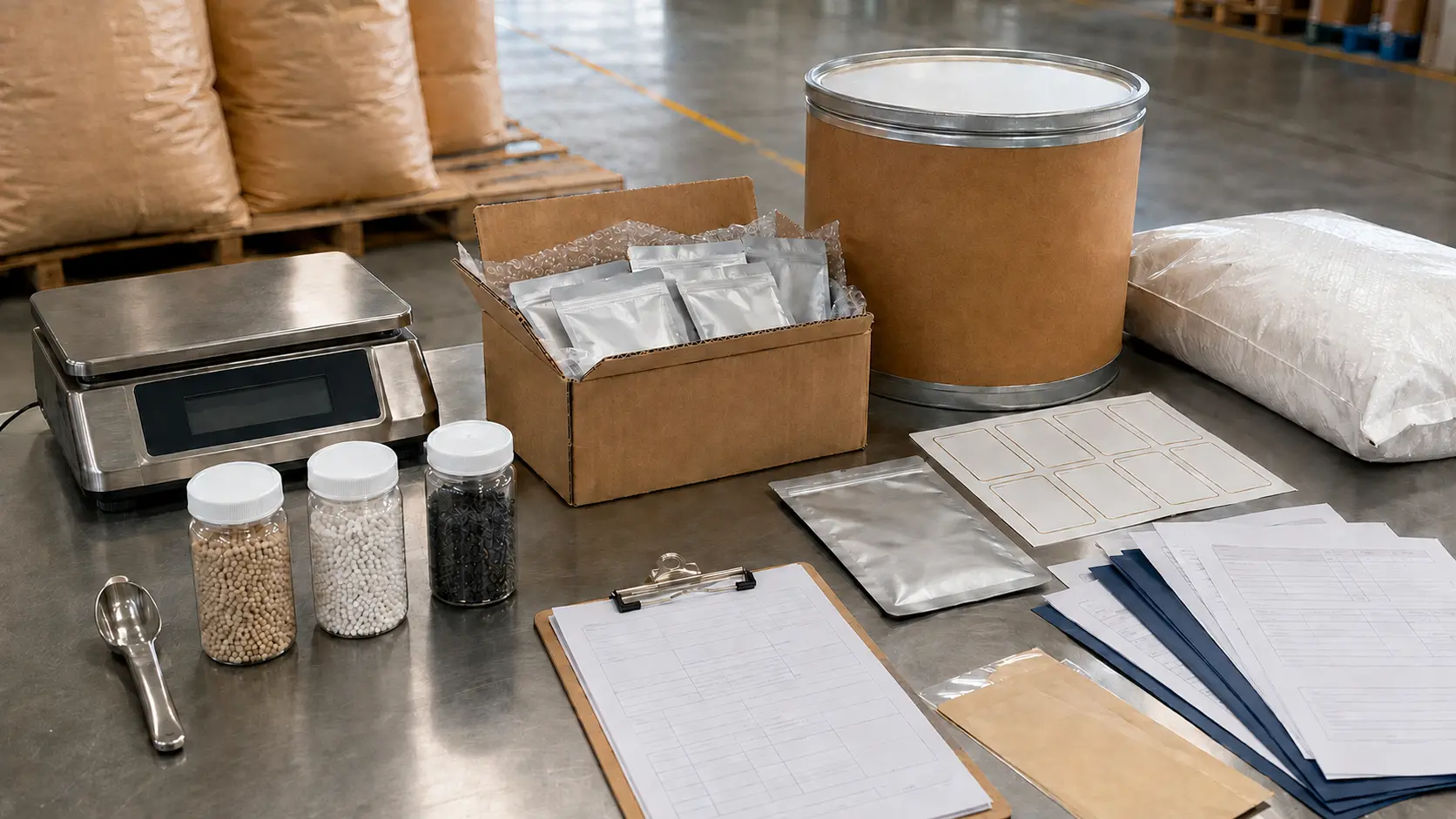
A useful RFQ should describe more than product and quantity. These inputs allow the packaging cost, pallet count, approximate shipment volume and document scope to be reviewed before order confirmation.
Product and Grade
State the product family, exact grade, particle form, size, bulk density and whether the material is moisture-sensitive, dusty, brittle or otherwise handling-sensitive.
Order Quantity
Provide sample, trial or bulk quantity and indicate whether the quantity is fixed by net material weight, package count, pallet count or container plan.
Primary Package
Specify bag, liner, drum, carton, small unit or FIBC direction, target net weight, closure, barrier and any customer-approved packaging material.
Pallet Requirements
State pallet material, maximum gross weight, preferred footprint and height, forklift limitations, stacking rule and any solid-wood restrictions.
Destination and Route
Provide country, delivery location, shipping mode, expected transit and storage time, transshipment risk and final warehouse conditions.
Labels and Marks
Provide required language, product description, grade, batch, net weight, origin, customer marks, barcode or other approved label fields.
Technical Files
List the TDS, SDS, COA, test method, retained sample, inspection photo or batch information needed before production or shipment.
Commercial and Shipping Files
State invoice, packing list, origin, inspection, transport or destination documents and clarify who is responsible for each requirement.
Classify the Risk
Identify moisture, dust, leakage, contamination, breakage, weight and handling risks for the exact material.
Build the Package
Define inner containment, outer protection, unit weight, closure, pallet and labeling requirements.
Plan the Shipment
Calculate package and pallet counts, gross weight, volume, load distribution and suitable restraint.
Verify Before Release
Check seals, weights, labels, lot records, samples, photos and the agreed document set before shipment.
Adsorbent Packaging and Export Guide FAQ
These answers establish a practical purchasing boundary. The final pack and shipment plan still require confirmation for the selected material, destination, transport mode and applicable requirements.
What is the standard export packaging for industrial adsorbents?
There is no single format suitable for every material and route. Common options include lined bags, high-barrier bags, drums, cartons, small sealed units and FIBCs, often palletized for export. The complete specification should state the liner, closure, outer package, net weight, pallet arrangement and securing method.
Are 25 kg bags suitable for every adsorbent?
No. A 25 kg bag may be practical for many granular products, but suitability depends on material density, moisture sensitivity, dust, package strength, manual-handling policy, pallet load and customer equipment. Some products or customers may require other unit weights or rigid containers.
How should molecular sieve be protected from moisture?
Use a packaging system with a suitable moisture barrier and verified closure, protect that barrier against puncture, minimize exposure between filling and sealing, store unopened packages under controlled conditions and define a resealing or immediate-use procedure for partly used material.
Is a TDS the same as a COA?
No. A TDS usually describes the product grade, typical values or specification direction. A COA is associated with an actual batch or lot and reports or confirms relevant results against an agreed basis. Buyers should confirm the test methods, units and acceptance limits used.
Does an SDS prove that a product can be shipped as non-dangerous goods?
Do not rely on a generic conclusion. Review the current SDS and the exact product classification against the transport mode, carrier requirements and destination rules. Product form, composition and applicable regulations can affect the required transport handling and documentation.
What should appear on an adsorbent package label?
Common fields include the agreed product name, grade, batch or lot, net weight, package number, origin or date fields where required, handling information and customer marks. The final wording, language and format should be approved before printing or application.
Can sample packaging be the same as bulk packaging?
Not automatically. Samples need representative material, effective sealing, leak and moisture protection, clear traceability, suitable secondary containment and acceptance by the selected courier. Small-package surface-area and headspace effects may also differ from bulk packs.
What information is needed to quote packaging and export delivery?
Send the product and grade, quantity, unit net weight, preferred package, pallet limits, destination, shipping mode, delivery term, label fields, technical documents, commercial documents and any destination-specific packaging or inspection requirement.
Confirm Packaging Before the Adsorbent Quotation Is Finalized
Send the product, quantity, preferred package, destination, shipping method, labeling and document requirements. Adsorbent Source reviews the requested grade, packaging and export-supply requirements; sample and document availability can be checked for each inquiry.
TDS vs SDS vs COA for Adsorbents →
How to Choose Silica Gel Desiccant →
Molecular Sieves Product Range →
Activated Alumina Product Range →
Carbon Adsorbents Product Range →
Silica Gel Product Range →
Before shipping a bulk order, check actual batch identity, packing seals and release evidence in the Bulk Adsorbent Pre-Shipment Inspection Checklist. After delivery, use the Incoming Goods and Warehouse Receiving Checklist to verify packaging condition, lot records and receiving status.