Compressed Air Drying Adsorbents for Adsorption Air Dryer Systems
Compare activated alumina, 4A molecular sieve and 3A molecular sieve for adsorption air dryers and regenerative compressed air dryer systems according to dryer type, inlet condition, target pressure dew point, regeneration method, particle size and replacement requirements.
Which Adsorbent Should You Review First?
For an adsorption air dryer, start from the required pressure dew point, original dryer specification and regeneration method. Use the following routes for an initial purchasing review.
Activated Alumina
A common first material to review for regenerative compressed air dryers where moisture capacity, mechanical strength and repeated regeneration cycles must be balanced.
Activated Alumina Desiccant for Air Dryers →4A Molecular Sieve
Review 4A molecular sieve when the dryer specification, layered bed design or dew-point target requires molecular sieve.
4A Molecular Sieve for Deep Drying →3A Molecular Sieve
Review 3A when the original equipment specification or gas composition calls for selective water adsorption.
3A Molecular Sieve for Selective Drying →Why Compressed Air Systems Require Effective Drying
Atmospheric air contains water vapor. During compression and subsequent cooling, part of this moisture can condense inside the compressed air system. Filters and separators can remove liquid water, but deeper moisture removal normally requires a suitable drying process.
Adsorption dryers use a solid desiccant bed to capture remaining water vapor. The required drying depth depends on the downstream process, local operating conditions and the pressure dew point that the system must achieve.
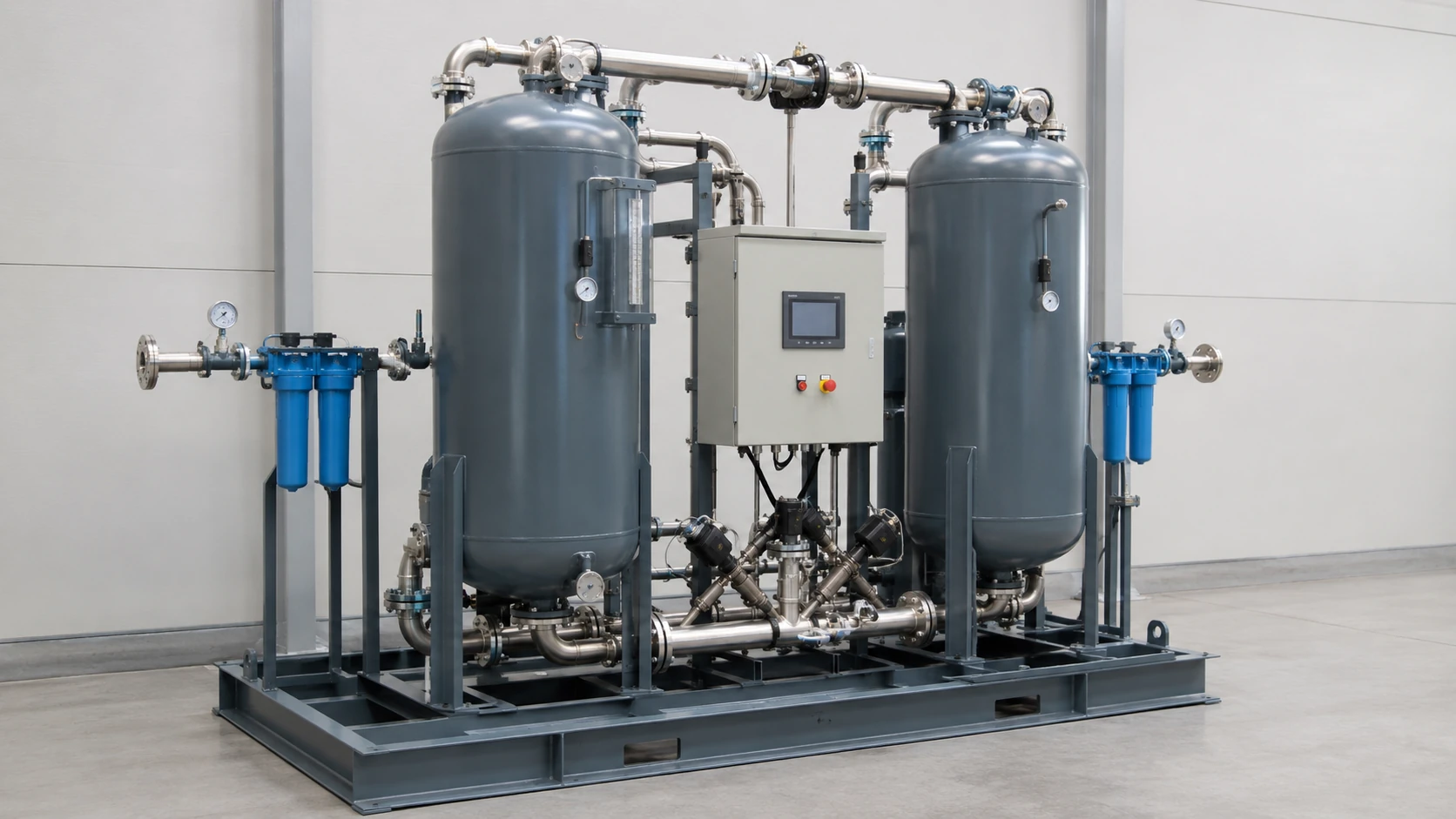
How a Twin-Tower Desiccant Air Dryer Works
Most regenerative adsorption dryers alternate between two towers. One tower dries the compressed air while the other tower regenerates the saturated desiccant.
Wet Air Enters
Pretreated compressed air enters the active adsorption tower after liquid water and oil aerosols have been controlled.
Moisture Is Adsorbed
Water vapor is retained on the internal surface of the activated alumina or molecular sieve bed.
Dry Air Leaves
The dried air exits the tower and continues to the downstream instrument, production or process air system.
The Beds Switch
The second tower is regenerated and cooled before the dryer changes towers according to its operating cycle.
Compressed Air Drying Adsorbents: Material Options
Compressed air drying adsorbents for an adsorption air dryer commonly include activated alumina and selected molecular sieve grades. These materials should not be treated as automatically interchangeable because the correct choice depends on the dryer design and required pressure dew point.
The initial material direction should be based on target dew point, dryer type, regeneration capacity, inlet air condition, pressure drop, particle form and the original equipment design.
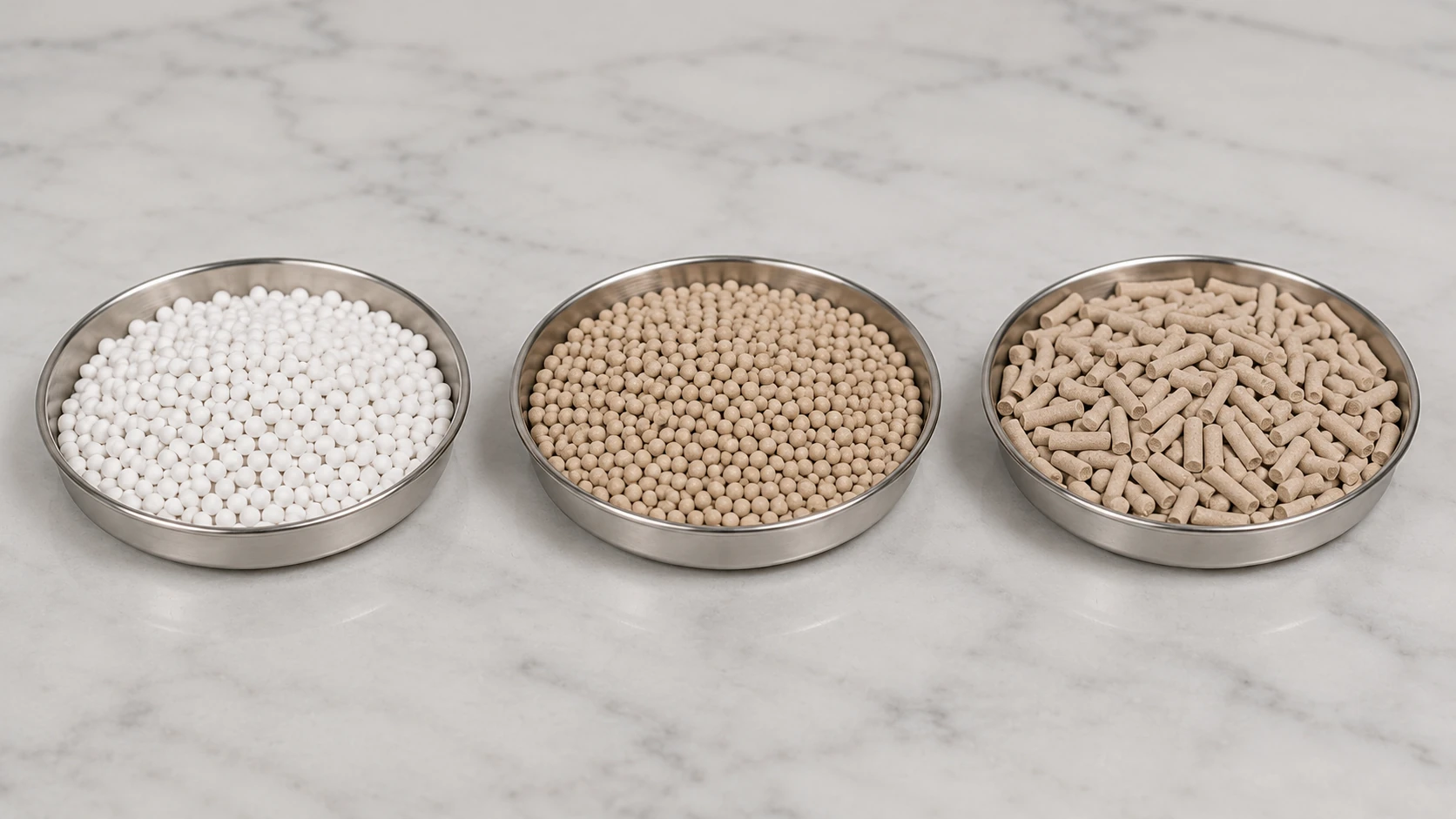
Activated Alumina Desiccant
Activated alumina is commonly reviewed for regenerative compressed air dryers where moisture capacity, mechanical strength, pressure drop and repeated adsorption cycles must be balanced.
- Heatless, heated and blower purge dryer projects
- New dryer filling and replacement projects
- Available in spherical bead forms
- Particle size must match the dryer design
Browse Activated Alumina Product Range →
4A Molecular Sieve
4A molecular sieve may be considered when a compressed air or process gas system requires deeper dehydration or when the existing dryer design specifies a molecular sieve layer or full molecular sieve bed.
- Deep moisture removal direction
- Bead or pellet forms depending on grade
- Single-material or layered-bed use
- Regeneration conditions must be confirmed
3A Molecular Sieve
3A molecular sieve is normally considered when selective moisture adsorption is required and the adsorption of some larger molecules needs to be limited.
- Selected air and gas drying applications
- Existing systems that specify a 3A grade
- Requires review of the feed composition
- Not the automatic default for every air dryer
When outlet moisture or dew point changes, review Molecular Sieve Performance Troubleshooting together with regeneration and bed data.
Activated Alumina vs 4A and 3A Molecular Sieve for Air Dryers
The main compressed air drying adsorbents differ in adsorption behavior, regeneration requirements, particle form and suitable operating conditions. Use this matrix to identify an initial material direction.
| Selection Factor | Activated Alumina | 4A Molecular Sieve | 3A Molecular Sieve |
|---|---|---|---|
| Primary Direction | General regenerative air and gas drying | Deep dehydration and broad moisture adsorption | Selective moisture adsorption |
| Common Dryer Use | Widely reviewed for industrial desiccant dryers | Deep-drying, layered-bed or specified systems | Selected systems based on gas composition |
| Dew Point Direction | Standard to low dew-point requirements depending on design | Often considered for more demanding drying targets | Application and system dependent |
| Material Form | Primarily spherical beads | Beads or pellets depending on grade | Beads or pellets depending on grade |
| Mechanical Review | Crush strength, attrition and dust control | Grade strength, attrition and cycling stability | Grade strength, attrition and cycling stability |
| Pressure Drop | Controlled through bead size and bed condition | Controlled through particle form and size | Controlled through particle form and size |
| Key Confirmation | Dryer model, operating condition and particle size | Dew point, regeneration and bed arrangement | Feed composition and existing system specification |
Adsorption Air Dryer Type Affects Adsorbent Selection
Different adsorption air dryer designs place different operating demands on compressed air drying adsorbents. Regeneration method, cycle time, purge strategy and available heat directly influence the conditions experienced by the desiccant bed.
Heatless Desiccant Dryer
Uses a portion of dried compressed air for regeneration. Confirm purge rate, cycle time, operating pressure, particle size and required pressure dew point.
Heated Purge Dryer
Adds heat to improve regeneration. Review regeneration temperature, heating time, cooling sequence and compatibility with the selected adsorbent grade.
Blower Purge Dryer
Uses ambient or externally supplied air during regeneration. Confirm heater capacity, regeneration flow and the influence of ambient humidity.
Heat of Compression Dryer
Uses compressor heat for regeneration. The compressor type, temperature profile, cooling process and dryer configuration must be reviewed.
Modular Desiccant Dryer
Compact vessels and short cycles can impose different requirements for particle size, flow distribution, pressure drop and mechanical durability.
Existing Replacement Project
Regenerate or Replace Molecular Sieve? →
Start with the original dryer manual, current adsorbent, particle size, filling weight, bed depth and current operating problem before changing materials.
Can Activated Alumina and Molecular Sieve Be Loaded Together?
Some dryer designs use a single adsorbent, while others use activated alumina and molecular sieve in separate layers. A layered bed may be designed to balance bulk moisture removal, deeper drying, pressure drop and regeneration performance.
The loading ratio should not be selected from a universal formula. It must be confirmed according to the original dryer design, bed height, target dew point, operating cycle, regeneration capacity and manufacturer instructions.
Why a Dryer May Still Miss Its Dew-Point Target
Poor dryer performance is not always caused by the adsorbent. The complete air treatment and regeneration system should be reviewed.
Pressure Dew Point and ISO 8573-1: What to Specify Before Refill
ISO 8573-1:2010 classifies compressed-air purity for particles, water and oil. For an adsorption dryer project, confirm the required water-purity class or pressure-dew-point target with the equipment specification and the pressure at which dew point is defined or measured. The standard does not certify an individual adsorbent grade.
Send with an RFQ: dryer model, actual operating pressure, inlet temperature, inlet moisture or dew point (if available), required outlet pressure dew point, regeneration method and cycle, current bed materials and quantities, particle size, and any oil or liquid-water carryover history. A material change or layered-bed design must be checked against the dryer manufacturer’s requirements. For a refinery or industrial plant instrument-air header, use the Instrument Air Dryer Desiccant Guide to prepare the more specific replacement specification and vendor records.
For documentation, request the grade-specific TDS / SDS / COA information and send the dryer duty and existing media specification for review. Achieving a specified air-purity class depends on the complete dryer system, operating conditions and appropriate verification—not on adsorbent selection alone.
Information Needed for an Air Dryer Adsorbent Quote
The more accurately the adsorption air dryer and operating conditions are described, the easier it is to compare particle size, material direction, filling quantity, packaging and document requirements for a replacement or new filling project.
Send Your Adsorption Air Dryer Conditions
Adsorbent Source supplies industrial adsorbents and provides grade and specification review for activated alumina, 4A molecular sieve and 3A molecular sieve. Share the dryer data and new-fill or replacement requirements so the requested grades and quotation needs can be reviewed.
Sample and TDS, SDS and COA availability, moisture-resistant packaging and export-supply details can be checked for the requested grade and order requirements.
Request Air Dryer Adsorbent QuoteWhatsApp: +86 158 5335 1678
Adsorption Air Dryer and Desiccant Questions
What adsorbent is commonly used in adsorption air dryers?
Activated alumina is commonly reviewed for regenerative adsorption air dryers. Molecular sieve may also be used when deeper drying, selective adsorption or a specific dryer design requires it.
Is activated alumina or molecular sieve better for compressed air drying?
Neither material is universally better. The selection depends on the target dew point, dryer type, inlet condition, regeneration capacity, pressure drop and original bed design.
Can activated alumina and molecular sieve be loaded together?
Yes, some dryer systems use layered beds. The material ratio and loading sequence must be confirmed from the dryer design, target performance and regeneration conditions.
Which molecular sieve is used for compressed air drying?
4A molecular sieve is commonly reviewed for broad air and gas dehydration. 3A may be considered when selective moisture adsorption is required. The selected grade must match the actual gas stream and dryer design.
How is the required adsorbent filling quantity calculated?
Filling quantity depends on tower dimensions, bed height, selected material bulk density, dryer design and the original equipment specification. Existing replacement projects should begin with the original loading data.
Why does a desiccant dryer fail to reach the required dew point?
Possible causes include liquid water carryover, oil contamination, high inlet temperature, insufficient regeneration, valve problems, bed channeling, incorrect particle size or an unsuitable cooling sequence.
Can Adsorbent Source support an existing dryer replacement project?
Yes. Provide the dryer model, current adsorbent, particle size, filling quantity, operating conditions, target dew point and replacement reason for an initial material and supply review.
What product documents may be available?
Availability of TDS, SDS, COA, packing information and export documents depends on the requested grade and order requirements and can be checked for each inquiry.
Review the Adsorption Air Dryer Before Selecting Desiccant
Send the dryer model, operating pressure, inlet temperature, flow rate, target pressure dew point, existing adsorbent and required quantity. We can review relevant grades, replacement compatibility, document availability and export-supply requirements against the dryer data.