Hydrogen dehydration · Molecular sieve supply
Molecular Sieve for Hydrogen Gas Drying
Need adsorbent media for hydrogen gas dehydration or replacement of an existing H₂ dryer bed? Compare candidate 3A and 4A molecular sieve grades, define the feed moisture and outlet specification, and prepare a technical RFQ before ordering bulk desiccant.
| MEASUREMENT 01 | Feed moisture | Attach actual inlet H₂O result and units, including conditions and test basis. |
|---|---|---|
| TARGET 02 | Required outlet | Define water ppmv or dew point together with reference pressure and method. |
| GRADE 03 | 3A or 4A review | Check co-components, regeneration and exact product data before deciding. |
| REPLACEMENT 04 | Original dryer record | Provide installed grade, vessel details and approved charge quantity. |
Moisture data and targets are deliberately blank until the buyer supplies verified results. For multi-impurity hydrogen separation, use the Hydrogen PSA Purification Guide.
How Is Water Removed From Hydrogen Gas?
For suitable hydrogen gas streams, molecular sieve adsorption can remove water to meet an application-specific moisture specification. 3A and 4A are possible starting grades for dehydration review, but selecting a commercial adsorbent requires verified feed composition, operating conditions, regeneration design and the supplier’s actual grade-specific data.
A hydrogen stream may be produced, recovered or recirculated in chemical and refinery operations. Moisture-control requirements vary with downstream equipment and the purpose of drying. The buyer should state the required water result and how it will be measured, rather than assuming that a nominal 3A or 4A grade guarantees a particular outlet dew point.
This page is for buyers sourcing molecular sieve media for hydrogen drying. Hydrogen PSA purification—selective removal of additional impurities from hydrogen-rich feed—is a different adsorbent duty and is explained separately below.
Confirm the Hydrogen Feed Before Choosing Desiccant
A material quotation should begin with the stream actually entering the dryer. Feed impurities such as carbon dioxide, carbon monoxide, methane, nitrogen, sulfur species or oil aerosols may change the appropriate pretreatment and adsorbent approach.
- Gas composition: hydrogen concentration and all known other components, including potential upsets.
- Moisture duty: inlet H₂O level, required outlet H₂O or dew point, units and test method.
- Operating data: actual/normal gas flow, pressure, temperature and operating schedule.
- Dryer arrangement: vessel dimensions, existing material layering, regeneration method and cycle limitations.
- Service requirements: dust control, contaminant carryover, startup and storage conditions, and approved product documentation.
If the stream or adsorber is new, process validation should be completed by the responsible qualified engineering team before purchasing the media.
3A vs 4A Molecular Sieve for Hydrogen Dehydration
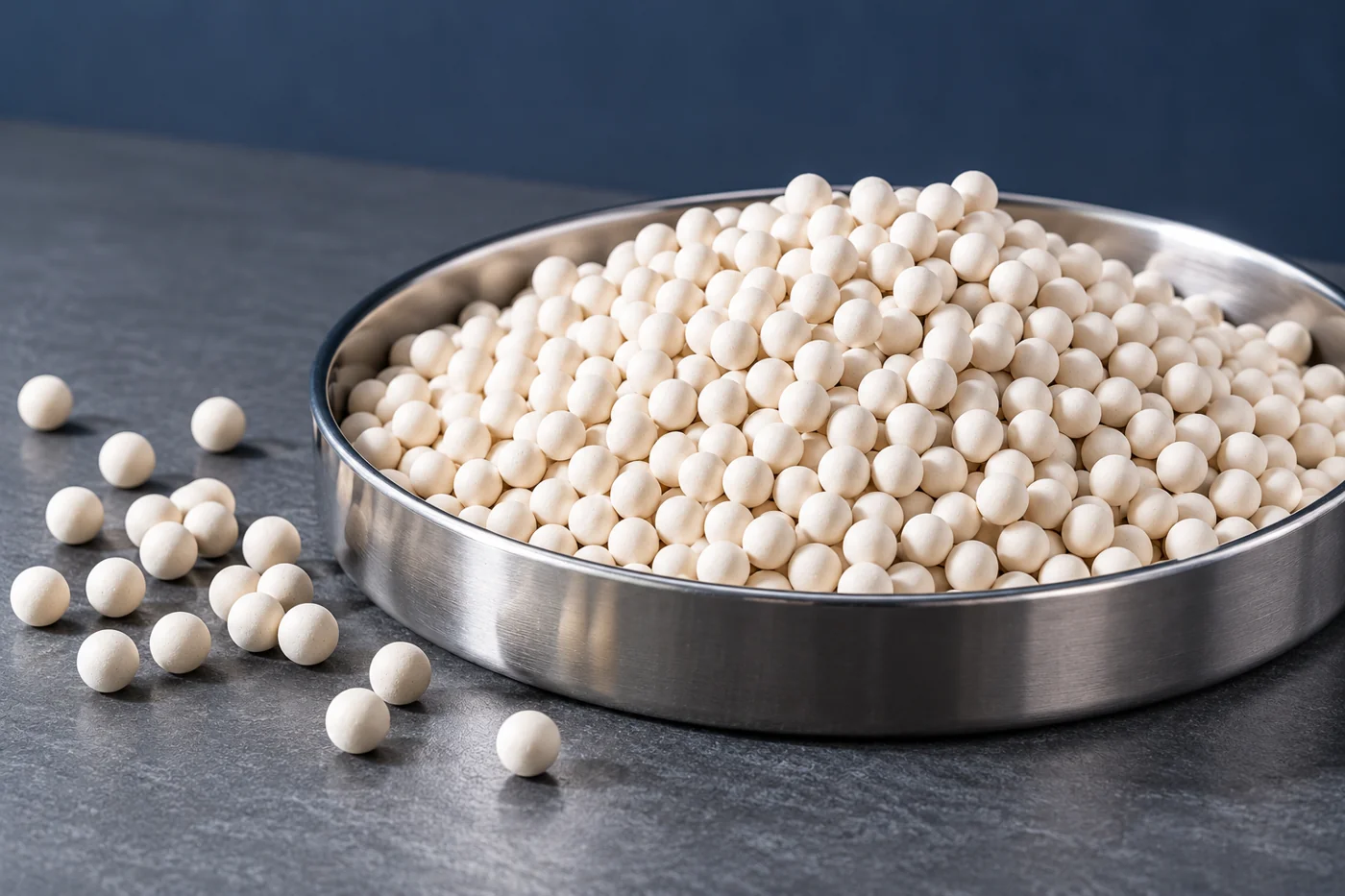
Both grades have applications in selected industrial drying duties, but they are not automatically interchangeable. The available commercial grade and stream impurity profile should determine the final choice.
Swipe horizontally to review all technical and purchasing fields →
| Review area | 3A molecular sieve | 4A molecular sieve |
|---|---|---|
| Primary buying question | Is selective water removal needed while minimizing uptake of larger co-components? | Is a broader small-molecule adsorption window acceptable for the hydrogen feed? |
| Nominal pore designation | About 3 Å; nominal grade classification, not a capacity guarantee | About 4 Å; nominal grade classification, not a process approval |
| Process considerations | Hydrogen composition, actual water target, co-adsorption and regeneration behavior | Hydrogen composition, potential co-adsorption of other small molecules, cycle and regeneration |
| Replacement compatibility | Match original approved grade, particle shape/size, bulk density and vessel loading | Match original approved grade, particle shape/size, bulk density and vessel loading |
| Documents to confirm | Current grade-specific TDS/SDS, batch COA when available, particle-size and strength data | Current grade-specific TDS/SDS, batch COA when available, particle-size and strength data |
3A Molecular Sieve
Start with the 3A product information when water selectivity is a primary consideration. Request confirmation against your hydrogen stream.
4A Molecular Sieve
Compare the specific 4A grade’s adsorption and regeneration characteristics against the required drying duty.
TDS and COA Comparison
Use the grade documentation guide to review the acceptance basis before approving samples or purchasing.
Hydrogen Drying Is Not the Same as Hydrogen PSA Purification
If your project is intended to separate CO, CO₂, CH₄, N₂ or other impurities from hydrogen-rich gas using pressure cycling, start with the dedicated PSA hydrogen purification adsorbents procurement guide rather than a water-only dryer material specification.
Hydrogen dehydration targets water removal from a gas stream and may use an appropriately selected regenerative dryer bed. The key procurement variables are H₂O loading, outlet moisture target, material compatibility and regeneration.
Hydrogen PSA purification is generally a multi-adsorbent, multi-bed separation process designed to remove several non-hydrogen components from a hydrogen-rich feed. Depending on process design, adsorbent layers can involve different materials, including activated carbon, activated alumina and zeolite molecular sieves. Some 5A and 13X grades are considered for selected impurity-removal duties, not as universally interchangeable water-only replacements.
For inquiries about broader gas adsorption, review 5A Molecular Sieve and 13X Molecular Sieve, and provide the actual PSA process specification. Do not substitute these media into a dryer or PSA unit without engineering approval.
What to Check Before Replacing Hydrogen Dryer Molecular Sieve
For a maintenance or turnaround purchase, the existing adsorbent specification is usually the best starting point. Provide any original OEM documentation and confirm that a proposed substitute is compatible with the equipment.
Original media data
Trade name, grade, bead or pellet size, charge quantity and available product documents.
Bed and cycle data
Vessel size, any layered media arrangement, regeneration method, cycle timing and pressure-drop limits.
Observed performance
Outlet moisture results, suspected contamination, attrition or dust issues and previous service history.
Where performance has declined, verify upstream water or contaminant loading and dryer operating conditions before attributing the result to adsorbent aging alone. Also see the molecular sieve replacement checklist and filling quantity guide.
Hydrogen Molecular Sieve RFQ Checklist
To prepare a reliable bulk quotation, send your existing media data sheet or the following requirements. Fields not yet available can be marked to be confirmed.
Swipe horizontally to review all technical and purchasing fields →
| RFQ field | Information to provide | Why it is needed |
|---|---|---|
| Service definition | Hydrogen drying only, hydrogen recovery, PSA purification or another specified duty | Prevents selection of adsorbent for the wrong process |
| Feed composition | Hydrogen purity, known component breakdown, expected contaminants and relevant variations | Checks co-adsorption and pretreatment needs |
| Water specification | Inlet moisture, target outlet level, units (such as ppmv or dew point) and measurement method | Defines an auditable drying objective |
| Operating conditions | Actual/normal gas flow basis, pressure and temperature ranges, operating schedule | Supports applicable grade and vessel assessment |
| Adsorber details | Vessel dimensions, current charge, bed layers, regeneration method and cycle information | Checks replacement compatibility |
| Product specification | Requested grade, particle form and size, mechanical requirements, SDS/TDS/COA needs | Defines commercial material acceptance |
| Commercial requirements | Trial/sample quantity or bulk mass, packaging, destination, Incoterm and required timing | Enables supply quotation |
Hydrogen Gas Drying with Molecular Sieve: Questions Buyers Ask
Can molecular sieve remove water from hydrogen gas?
Yes, suitable molecular sieve adsorption media can be used for water removal from certain hydrogen streams. Performance depends on the specific commercial grade and process conditions.
Should I use 3A or 4A for hydrogen dehydration?
Both are candidate starting points for selected drying systems. Confirm the feed impurity profile, moisture specification, regeneration process and product-specific technical information before choosing.
Does molecular sieve drying produce hydrogen suitable for fuel cells?
Drying removes water, not every contaminant. Any fuel-cell or other high-purity hydrogen standard requires independent assessment of the complete gas purification system and all applicable impurity limits.
Is a hydrogen PSA molecular sieve interchangeable with dryer molecular sieve?
No. PSA hydrogen purification can target carbon dioxide, carbon monoxide, nitrogen, hydrocarbons or other impurities using multiple adsorbent layers. A water-drying bed has a distinct process duty.
What should I provide for an existing hydrogen dryer media replacement?
Provide the OEM or original adsorbent grade, size, bed loading, hydrogen composition, moisture target, operating conditions and regeneration cycle. Send the existing TDS if available.
Can you guarantee a particular outlet dew point?
A guaranteed outlet result cannot be determined from the generic material name alone. It requires process-specific design and grade-specific verification, agreed testing and technical acceptance conditions.
Request Molecular Sieve for Hydrogen Gas Drying
Send your hydrogen drying application details or existing adsorbent specification. We can review suitable supply directions, available product grades, physical forms, samples, technical documents, packaging and export quote terms subject to verification.
Describe the gas
Hydrogen concentration, impurities, inlet/outlet moisture and operating conditions.
Identify the adsorbent
Current or proposed grade, particle size, charge quantity and regeneration.
Request a supply offer
Required mass, grade documentation, packing format, destination and delivery target.