Natural Gas Dehydration Adsorbents for Molecular Sieve Dryer Systems
Compare natural gas dehydration adsorbents including 3A, 4A, 5A and 13X molecular sieve directions for natural gas drying, NGL processing, LNG pretreatment and adsorption-bed replacement according to gas composition, outlet specification, regeneration conditions and equipment design.
How to Select Molecular Sieve →
3A vs 4A vs 5A vs 13X Molecular Sieve →
TDS vs SDS vs COA for Adsorbents →
Adsorbent Packaging and Export Guide →
Why Natural Gas Must Be Dehydrated
Produced and processed natural gas normally contains water vapor. Depending on pressure, temperature and composition, this moisture can condense or contribute to hydrate formation when the gas is cooled, expanded, transported or processed at low temperature.
Natural gas dehydration adsorbents are used when the process requires deeper moisture removal than bulk liquid separation or conventional conditioning alone can provide. Buyers comparing the wider grade family can also review our Molecular Sieves product hub. The required outlet condition depends on the downstream pipeline, NGL, LNG or cryogenic processing specification.
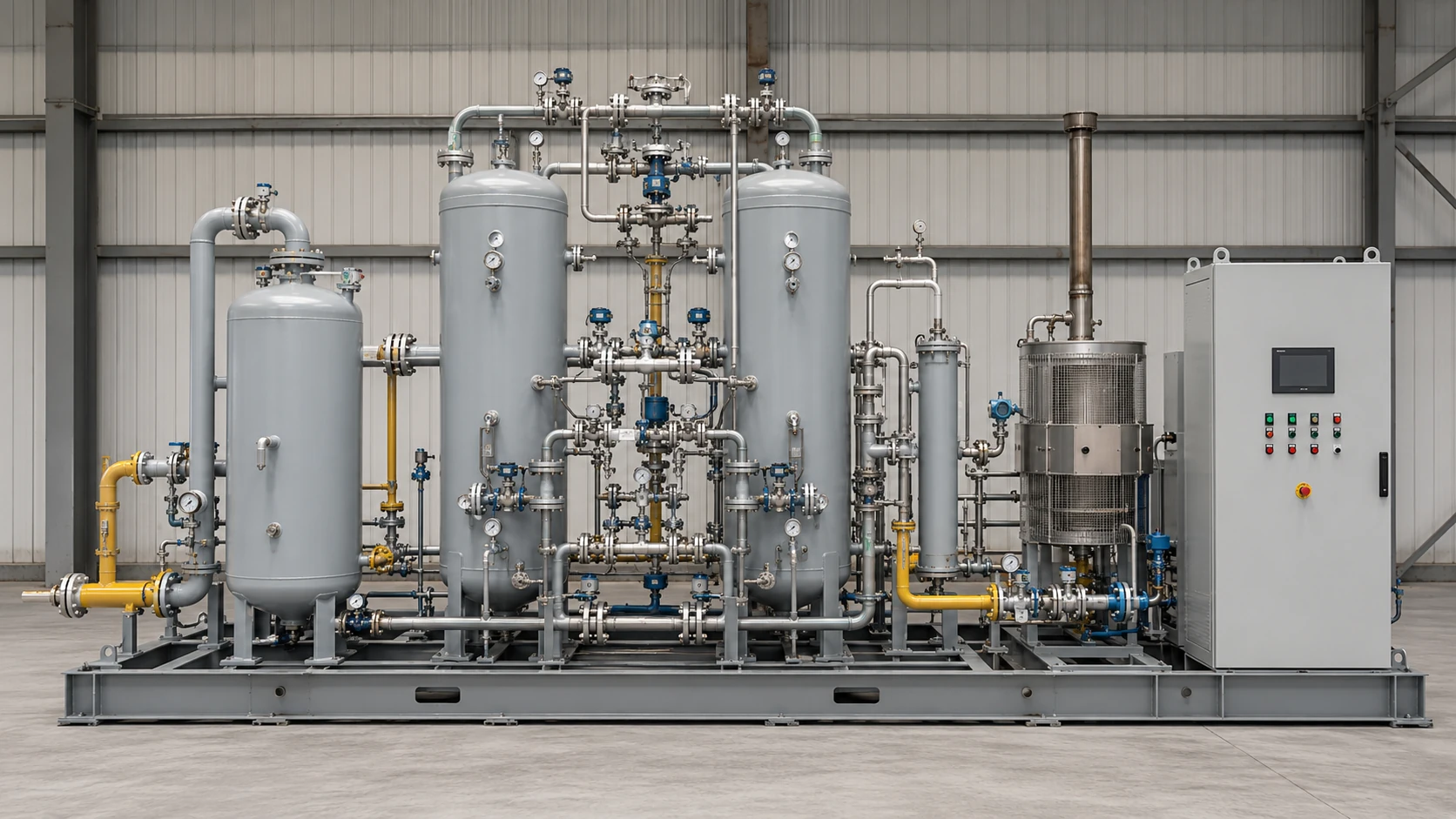
How a Natural Gas Molecular Sieve Dehydration Unit Works
A complete system normally combines inlet liquid separation, filtration, adsorption, regeneration and cooling. The molecular sieve bed should not be expected to replace proper liquid and contaminant control upstream.
Feed Separation
An inlet separator removes free liquid water, condensed hydrocarbons and bulk entrained liquid before the gas reaches the adsorption vessels.
Gas Pretreatment
Coalescing and particulate filtration helps control droplets, solids, oil and other contaminants that may damage the molecular sieve bed.
Water Adsorption
Natural gas flows through the active vessel while the selected molecular sieve adsorbs water and, depending on the grade, selected additional components.
Regeneration and Cooling
The offline bed is heated, purged and cooled before returning to adsorption. The towers alternate according to the process cycle.
Natural Gas Dehydration Adsorbents: Grade Options
Molecular sieve grade selection should begin with the gas composition and process objective, not only the nominal pore size or the name printed on an existing drum.
4A molecular sieve is a common starting direction for general natural gas dehydration. 3A molecular sieve may be considered for more selective water removal, while 5A and 13X are normally reviewed when the process includes additional purification or broader adsorption requirements.

3A Molecular Sieve
3A molecular sieve has a smaller effective pore opening and is reviewed when water must be removed while limiting access for many larger hydrocarbon molecules.
- Selected hydrocarbon gas and liquid streams
- Processes where reducing co-adsorption matters
- Existing systems that specify an application-grade 3A
- Full stream composition must be reviewed
4A Molecular Sieve
4A molecular sieve is commonly reviewed for general gas dehydration and natural gas dryer systems requiring deep water removal under suitable adsorption and regeneration conditions.
- Natural gas and process-gas dehydration
- NGL and selected liquid-hydrocarbon drying
- New dryer loading and existing-bed replacement
- Particle form and dynamic data must be confirmed
5A Molecular Sieve
5A molecular sieve permits access for selected molecules excluded by 3A and 4A. It is normally reviewed for defined purification, separation or impurity-control duties.
- Selected natural gas purification processes
- Specific sulfur or separation routes
- Process-design confirmation is essential
- Not a universal substitute for 4A
13X Molecular Sieve
13X has a larger effective pore opening and is reviewed where water, carbon dioxide or a wider range of accessible impurities must be controlled.
- Broad gas purification direction
- CO₂ and moisture removal projects
- LNG or cryogenic pretreatment review
- Co-adsorption and regeneration load must be checked
3A vs 4A vs 5A vs 13X Natural Gas Dehydration Adsorbents
The table provides an initial purchasing comparison. Final selection requires the complete gas composition, outlet specification, equipment design and supplier-specific dynamic data.
| Selection Factor | 3A | 4A | 5A | 13X |
|---|---|---|---|---|
| Main Direction | Selective water removal | General deep dehydration | Selected purification and separation | Broad impurity adsorption |
| Natural Gas Use | Selected hydrocarbon streams | Common starting direction | Process-specific duties | Purification-specific duties |
| Water Adsorption | Yes | Yes | Yes | Yes |
| Co-adsorption Direction | More restricted | Broader than 3A | Broader than 4A | Broadest of these grades |
| CO₂ Removal Direction | Limited and application-specific | Application-specific | Selected processes | Common comparison direction |
| Primary Selection Basis | Hydrocarbon retention and selectivity | Deep dehydration performance | Defined impurity or separation target | Broad gas purification requirement |
| Final Confirmation | Full gas composition | Full gas composition and dryer cycle | Process licensor or equipment design | Process design and impurity loading |
Gas Composition Requirements for Natural Gas Dehydration Adsorbents
Describing the duty only as “natural gas dehydration” is not enough to approve a molecular sieve grade. Water competes with other feed components, and contaminants can change usable capacity, cycle length and service life.
Pipeline Gas, NGL and LNG Have Different Drying Requirements
The required adsorbent and outlet specification depend on what happens after the molecular sieve dryer.
Pipeline Natural Gas
Pipeline conditioning focuses on meeting the applicable moisture or dew-point requirement while maintaining reliable long-term operation.
- Control water and hydrate risk
- Support pipeline specification compliance
- Review pressure, temperature and flow variation
- Balance cycle life and regeneration demand
NGL Recovery and Hydrocarbon Processing
Gas entering expansion, refrigeration or low-temperature hydrocarbon recovery normally requires deeper moisture control.
- Reduce ice and hydrate formation
- Control condensate and heavy-hydrocarbon carryover
- Protect downstream cold equipment
- Review gas composition and recovery process
For a separate liquid-phase LPG or NGL dehydration duty, see our LPG and liquid hydrocarbon molecular sieve selection guide.
LNG and Cryogenic Pretreatment
LNG pretreatment requires very low residual moisture and may also require separate control of carbon dioxide, sulfur compounds, mercury and heavy hydrocarbons.
- Confirm the complete pretreatment train
- Review CO₂ and other freezing components
- Do not treat one general sieve as a universal solution
- Follow the equipment and process design basis
Why a Molecular Sieve Bed May Fail Early
Reduced capacity or early breakthrough may come from feed contamination, regeneration problems, equipment faults or changed operating conditions rather than the nominal sieve type alone.
Information Needed for a Natural Gas Dehydration Adsorbent Quote
Complete process data helps compare molecular sieve type, particle form, loading quantity, regeneration compatibility, packaging and document requirements.
Send the Gas Composition and Dryer Conditions
Adsorbent Source supplies industrial adsorbents and can review the requested molecular sieve grades and specifications against the gas composition, dryer conditions and quotation requirements provided.
Sample and TDS, SDS and COA availability, particle-size information, moisture-resistant packaging and export-supply details can be checked for the requested grade and order requirements.
Request Natural Gas Adsorbent Review
Review the Process and Product Data Together
Adsorbent Source supplies industrial adsorbents and can review the gas composition, dryer conditions, requested grade, specification, quantity and document requirements for each inquiry.
We do not approve outlet moisture, service life or replacement equivalence from a molecular sieve name alone. Final approval should be based on the selected product data and the actual process conditions.
Natural Gas Dehydration Adsorbents FAQ
Which molecular sieve is used for natural gas dehydration?
4A molecular sieve is a common initial direction for general natural gas dehydration. 3A may be reviewed for more selective water removal, while 5A and 13X are considered for defined purification or broader adsorption duties.
Is 3A or 4A molecular sieve better for natural gas drying?
Neither is universally better. 3A offers stronger molecular exclusion, while 4A is widely reviewed for general deep dehydration. The complete gas composition and downstream process determine which direction is suitable.
Can 13X molecular sieve be used for natural gas dehydration?
13X can adsorb water and a broader range of accessible components, including carbon dioxide under suitable conditions. It should be selected only when the process requires that broader adsorption behavior.
What gas composition is required before selecting a molecular sieve?
Provide methane, ethane and heavier hydrocarbons, water, CO₂, H₂S, sulfur compounds, methanol, glycol, compressor oil, condensate and any other relevant impurity information.
Why can liquid water damage a molecular sieve bed?
Liquid water creates a much higher load than water vapor and can cause severe heating during regeneration. Repeated liquid carryover may also contribute to attrition, channeling and shortened service life.
How is the required molecular sieve filling quantity calculated?
Filling quantity depends on vessel dimensions, bed height, bulk density, support layers, selected grade and the dryer design. Existing projects should begin with the original loading record and equipment drawing.
Why does a molecular sieve bed lose capacity early?
Common causes include liquid carryover, heavy hydrocarbons, glycol or methanol contamination, compressor oil, insufficient heating, low regeneration flow, poor cooling, channeling, particle breakage or changed feed conditions.
Can one molecular sieve bed remove water, H₂S, CO₂ and mercury?
A process may use different adsorbents or bed layers for different contaminants. Ordinary dehydration molecular sieve should not be assumed to provide complete removal of all impurities without a specific process and product review.
Can Adsorbent Source support an existing dryer replacement?
Yes. Provide the existing grade, supplier data, particle size, filling quantity, process conditions, regeneration data and current operating problem for an initial comparison.
What information should I send for a natural gas dehydration adsorbent quote?
Send the complete gas composition, inlet and target outlet moisture, adsorption pressure and temperature, flow rate, dryer dimensions, existing sieve grade and particle size, regeneration data, required quantity, destination and document requirements.
What product documents may be available?
Availability of TDS, SDS, COA, particle-size information, packing details and export documents depends on the requested grade and order requirements and can be checked for each inquiry.
Select the Adsorbent From the Gas Stream and Process Duty
Send the complete gas composition, inlet water content, outlet specification, pressure, temperature, flow, dryer dimensions, existing molecular sieve and regeneration conditions. Adsorbent Source can review suitable molecular sieve grades, document availability and export-supply requirements against the process data you provide.